Für diesen Konzeptentwurf wurde kein Prototyp entwickelt. Die Angaben zu AIS stammen von der öffentlichen Projektseite ais.schule und aus einer Durchsicht der AIS-Repositorien am 14.10.2026, die noch nicht öffentlich sind. Was daraus stammt, ist abstrahiert: Namen und Strukturen sind vereinfacht und auf Deutsch übertragen, Quelltext ist nicht wiedergegeben. AIS ist in Entwicklung; der Stand kann sich schnell ändern.
Ergebnis
- Fachlich passen beide zusammen. VERA liefert eine Diagnose, AIS will Lehrkräften bei Diagnostik, Förderung und Unterrichtsplanung helfen. Beide dienen ausdrücklich nicht der Benotung. Eine Rückmeldung, die nicht im Bericht endet, sondern in der Planung weiterwirkt, ist genau der Fall, für den AIS gedacht ist.
- Der erste Schritt kommt ohne personenbezogene Daten aus. Übergeben wird das Ergebnis der Lerngruppe: wie sich die Klasse auf die Kompetenzstufen verteilt und bei welchen Kompetenzen sie unter dem Vergleichswert liegt. Daraus kann ein Lernsystem Vorschläge für Lernpfade und Material ableiten, über die die Lehrkraft entscheidet.
- Es fehlt derselbe gemeinsame Schlüssel wie bei den Mediatheken. Die
Schnittstelle nennt Kompetenzen nur als Kürzel ohne Bezugssystem (
L2,3.3.b). Ein anderes System kann damit nichts anfangen, solange nicht feststeht, welcher Bildungsstandard gemeint ist. Die Lösung ist dieselbe wie auf der Seite Mediatheken einbinden: eine auflösbare Kennung je Kompetenz. - Einzelergebnisse sind die hohe Hürde. VERA-Codes und die Pseudonyme eines Lernsystems haben nichts gemeinsam. Eine Verknüpfung müsste die Lehrkraft selbst herstellen, und ob die Ergebnisse dafür überhaupt weitergegeben werden dürfen, ist eine Frage an die Länder, nicht an die Technik.
- Im AIS-Piloten treffen sich die Jahrgänge nicht. VERA wird in den Klassen 3 und 8 geschrieben, der Pilot arbeitet in den Klassen 5 und 6. Für eine Erprobung bräuchte es also entweder ältere VERA-3-Ergebnisse als Ausgangslage nach dem Übergang oder einen späteren Ausbau von AIS auf weitere Jahrgänge.
Die Fragestellung
Eine Rückmeldung ist ein Endpunkt: Die Lehrkraft liest sie, zieht Schlüsse und plant danach, meist im Kopf. Die vorigen Teilkonzepte haben untersucht, wie Material aus der Rückmeldung in die Lernplattform kommt. Hier geht es um die Ergebnisse selbst: Lassen sie sich an ein System übergeben, das mit ihnen weiterarbeitet, etwa indem es Lernpfade vorschlägt oder den Lernstand einer Klasse von Anfang an kennt, statt ihn erst mühsam zu ermitteln?
AIS.schule in Kürze
AIS (Adaptives Intelligentes System) ist ein Projekt des FWU im Auftrag der Länder, finanziert aus dem DigitalPakt Schule. Laut Projektseite entsteht eine KI-gestützte Lehr- und Lernumgebung für allgemeinbildende Schulen:
- Schüler:innen bekommen adaptive Lernpfade, die sich nach Lernstand und Lernfortschritt verändern, und einen KI-Tutor.
- Lehrkräfte bekommen einen Überblick über den Lernstand ihrer Klasse, ein Empfehlungssystem für die Unterrichtsplanung und einen Editor für Lernmaterial.
- Medienanbieter und die OER-Community können Material einstellen.
- AIS dient laut Projektseite nicht der Leistungsbewertung oder Benotung, sondern der Lernbegleitung.
- Zum Schuljahr 2026/27 startet ein Pilot an ausgewählten Schulen mit Material für Deutsch und Mathematik in den Klassen 5 und 6. Die Daten werden pseudonymisiert verarbeitet.
Wo Ergebnisse in AIS ankämen (abstrahiert)
Für eine Übergabe zählen in AIS drei Dinge: wie AIS den Lernstand führt, wie eine Lehrkraft plant und worauf sich beides fachlich bezieht.
// Fachmodell: Wissensbausteine, gebündelt zu Fertigkeiten und Bereichen,
// verbunden durch Voraussetzungen („erst A, dann B“).
type BausteinId = string;

// Lernstand: je Schüler:in und Wissensbaustein.
interface Lernstand {
  schueler: Pseudonym;     // kein Klarname, kein VERA-Code
  baustein: BausteinId;
  beherrschung: number;    // 0 … 1, aus den Antworten geschätzt
  verlauf: number[];
  versuche: number;        // 0 heißt: nie selbst gemessen, nur abgeleitet
}

// Überblick für Lehrkräfte: je Baustein verdichtet auf vier Klassen.
type Einordnung = 'beherrscht' | 'in Arbeit' | 'braucht Übung' | 'keine Daten';

// Planung: ein Abschnitt eines Lernpfads.
interface PlanAbschnitt {
  modus: 'beherrschen' | 'üben' | 'diagnose' | 'erkunden';
  bezug: { art: 'baustein' | 'fertigkeit' | 'bereich' | 'standard'; id: string }[];
  zugang?: {               // Differenzierung: wer diesen Abschnitt bekommt
    wenn: 'beherrschung unter' | 'beherrschung erreicht';
    baustein: BausteinId;
    schwelle: number;
  };
}
| Aus der Rückmeldung (TBA3) | In AIS | Passung |
|---|---|---|
| Kompetenz, Leitidee (heute nur als Kürzel) | Planbezug der Art standard |
Gut. Den Bezug auf einen Standard sieht die Planung schon vor. Es fehlen die Kennungen auf TBA3-Seite und eine Zuordnung Standard → Bausteine in AIS. |
| Stufenverteilung der Gruppe je Teilbereich | Einordnung je Baustein im Überblick |
Mittel. Andere Körnung: VERA misst Teilbereiche, AIS führt feine Bausteine. Für einen Kontext neben dem eigenen Bild (Weg 2) reicht das, für eine Verrechnung nicht. |
| Stufe I–V einer Person | Lernstand.beherrschung mit versuche = 0 |
Als Startwert denkbar. Die Unterscheidung zwischen „gemessen“ und „nur geschätzt“ gibt es schon, und ein VERA-Wert gehört klar zur zweiten Sorte. |
- Der Lernstand hat mit Absicht keinen Schreibweg von außen. Eine Anwendung darf ihn nicht setzen. Der Weg wurde geschlossen, damit sich niemand selbst einstufen kann. Ein Import von VERA-Ergebnissen bräuchte deshalb einen eigenen, ausgewiesenen Weg, der die Herkunft mitschreibt, und keinen Umweg über die bestehende Oberfläche.
- Der Lehrplanbezug läuft über MEM, aber zu den Landeslehrplänen. AIS ordnet seine Bausteine über MEM den Lehrplänen einzelner Länder zu (bisher Bayern und Sachsen, maschinell vorgeschlagen und in Prüfung). Eine Zuordnung zu den KMK-Bildungsstandards des IQB, in denen VERA denkt, gibt es nicht. Und weil MEM selbst keinen Weg vom Bildungsstandard zum Landeslehrplan kennt (siehe Mediatheken einbinden), hilft auch der Umweg nicht. Diese Zuordnung wäre auf AIS-Seite neu zu bauen.
- Personen gibt es nur als Pseudonym. Die Schule ist nur als Prüfsumme hinterlegt, Klarnamen liegen getrennt in einer eigenen Ablage, und jede Datenbank trennt die Mandanten auf Zeilenebene. Einen gemeinsamen Schlüssel mit den VERA-Codes gibt es nicht, und das ist richtig so.
- Die Lernanalyse ist kein offener Learning Record Store. Der Dienst nimmt eine feste Liste von Verben an und nur von Diensten mit erhöhten Rechten. Das bestätigt die Einschätzung zu Weg 4 weiter unten.
In der Produktplanung von AIS stehen ein Lernstandsüberblick je Person, Übungsempfehlungen aus der Diagnostik und Lerngruppen mit verdichtetem Lernstand. Ein Gestaltungsentwurf zeigt den Lernstand je Standard auf einer fünfstufigen Skala von „keine“ über Mindest-, Regel- und Regelstandard plus bis „optimal“. Das entspricht fast genau den VERA-Stufen I bis V. Gebaut ist davon der Entwurf, nicht die Anwendung. Pläne, die TBA3 oder VERA ausdrücklich nennen, gibt es bisher nicht.
Was die Schnittstelle übergeben könnte
Die Auswertungsschnittstelle liefert Ergebnisse auf drei Ebenen (Lerngruppe,
Schule, Land) und jeweils wahlweise für die Gruppe oder für jede einzelne Person
(type=group oder type=students). Für die Weiterarbeit in einem Lernsystem
zählen vor allem diese Antworten:
| Antwort | Inhalt | Personenbezug |
|---|---|---|
/groups/{id}/competence-levels |
Verteilung der Gruppe auf die Kompetenzstufen I–V, je Teilbereich | nein |
/groups/{id}/items |
Lösungshäufigkeit je Aufgabe, mit Kompetenzbezug, Anforderungsbereich und Stufe der Aufgabe | nein |
/groups/{id}/aggregations?aggregation=competence |
Ergebnisse je Kompetenz, verdichtet | nein |
dieselben mit type=students |
dasselbe je Schüler:in, unter einem Code | ja, pseudonym |
/schools/…, /states/… |
Vergleichswerte für Schule und Land | nein |
Vier Wege, nach Eignung geordnet
1. Gruppenergebnis in die Planung
Die Lehrkraft übergibt aus der Rückmeldung das Ergebnis ihrer Klasse. Das Lernsystem macht daraus Vorschläge: welche Kompetenzen in den nächsten Wochen Vorrang haben und welche Lernpfade oder Materialien für welche Stufe passen. Die Lehrkraft nimmt die Vorschläge an, ändert oder verwirft sie.
- Was TBA3 liefern muss: je Kompetenz eine auflösbare Kennung, die Stufenverteilung und die Lösungshäufigkeit, dazu den Vergleichswert.
- Was das Lernsystem bieten muss: eine Stelle, an der eine Lehrkraft ein solches Paket für ihre Lerngruppe einspielt, und eine Zuordnung von Bildungsstandards zu den eigenen Lernzielen und Inhalten.
- Datenschutz: kein Personenbezug. Das ist der leichteste Fall.
2. Gruppenergebnis als Kontext im Überblick
Das Lernsystem zeigt das VERA-Ergebnis nur an, als zusätzliche Information neben seiner eigenen Einschätzung des Lernstands. Es macht daraus keine Vorschläge und rechnet es nicht in seine Einschätzung ein. Die Lehrkraft sieht dann zum Beispiel, dass die Klasse im VERA-Test bei Messen schwach war, im Lernsystem aber inzwischen aufgeholt hat.
- Was TBA3 liefern muss: dieselben Daten wie beim ersten Weg.
- Was das Lernsystem bieten muss: nur eine Stelle, an der es das Ergebnis anzeigt. Die Zuordnung von Bildungsstandards zu eigenen Lernzielen, die der erste Weg für seine Vorschläge braucht, entfällt.
- Datenschutz: kein Personenbezug.
3. Einzelergebnisse als Ausgangslage
Für jede Schülerin und jeden Schüler übernimmt das Lernsystem die erreichte Stufe als Startpunkt, statt den Lernstand erst über eigene Aufgaben zu ermitteln. Das wäre der größte Gewinn und die höchste Hürde:
- Kein gemeinsamer Schlüssel. VERA kennt die Kinder unter einem Testcode, ein Lernsystem unter seinem eigenen Pseudonym. Zusammenführen kann sie nur die Lehrkraft, und das am besten im eigenen Browser, sodass weder das Lernsystem die Testcodes noch die Schnittstelle die Pseudonyme erfährt.
- Eine Testleistung ist kein Lernstand. Ein VERA-Ergebnis zeigt, was ein Kind an einem bestimmten Tag im Test gezeigt hat. Ein Lernsystem sollte es deshalb nur als vorläufige Einschätzung übernehmen und dazu vermerken, dass sie aus VERA stammt und von welchem Testtag. Sobald das Lernsystem eigene Beobachtungen aus den Übungen des Kindes hat, sollten diese die VERA-Einschätzung ablösen.
- Die Weitergabe muss erlaubt sein. Wofür VERA-Ergebnisse verwendet werden dürfen, regeln die Länder. Ob eine Weitergabe an ein Lernsystem darunter fällt, muss vor jedem Bau geklärt sein.
4. Lernanalyse-Standards wie xAPI
xAPI beschreibt einzelne Lernhandlungen („hat Aufgabe 3 gelöst“) und sammelt sie in einem Learning Record Store. VERA-Ergebnisse sind das Gegenteil: verdichtete Testergebnisse, oft auf Gruppenebene. Man kann sie in Statements zerlegen, aber dabei geht verloren, was sie aussagekräftig macht (Stufe, Vergleichswert, Bezugsgruppe). Für die Übergabe von Ergebnissen ist ein eigenes, kleines Format passender. xAPI kommt erst in Frage, wenn einzelne Aufgabenantworten weitergegeben werden sollen.
Ein Übergabeformat als Entwurf
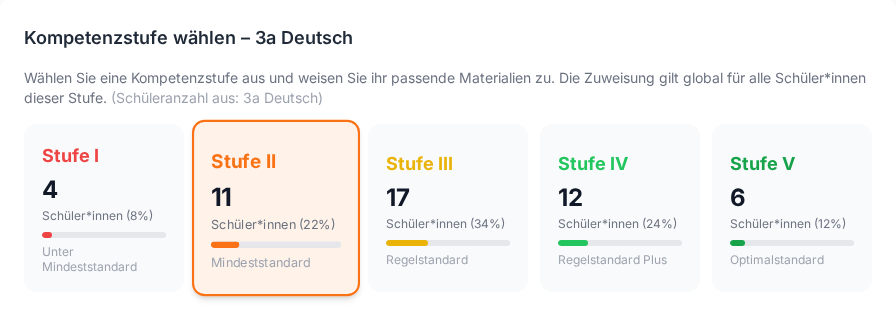
So könnte das Paket für den ersten Weg aussehen. Das Format ist ein Vorschlag dieser Studie, kein Teil der Schnittstelle und mit niemandem abgestimmt. Die Stufenverteilung stammt aus den Beispieldaten der Demoanwendung, die übrigen Zahlen sind zur Veranschaulichung gesetzt:
{
  "format": "tba3-ergebnispaket/0.1-entwurf",
  "erstellt": "2026-10-14",
  "test": {
    "name": "VERA 3 Deutsch",
    "bildungsstandards": "https://w3id.org/iqb/bista04-de-p/"
  },
  "lerngruppe": {
    "bezeichnung": "3a Deutsch",
    "fach": "Deutsch",
    "jahrgang": 3
  },
  "personenbezug": false,
  "teilbereiche": [
    {
      "kennung": "https://w3id.org/iqb/bista04-de-p/…",
      "bezeichnung": "Lesen – mit Texten und Medien umgehen",
      "kompetenzstufen": { "I": 0.08, "II": 0.22, "III": 0.34, "IV": 0.24, "V": 0.12 },
      "vergleich": { "ebene": "land", "mindeststandard_erreicht": 0.88 }
    }
  ],
  "kompetenzen": [
    {
      "kennung": "https://w3id.org/iqb/bista04-de-p/…",
      "kuerzel": "3.3",
      "bezeichnung": "Texte erschließen",
      "loesungshaeufigkeit": 0.61,
      "vergleich_land": 0.68
    }
  ]
}
- Die Kennung ist eine Adresse, das Kürzel nur Beiwerk.
kennungzeigt auf den Standard im Vokabular des IQB, wie es der Ontologieserver MEM führt. Ein empfangendes System kann sie nachschlagen, statt eine Liste von Kürzeln je Fach und Fassung pflegen zu müssen. Die…stehen für die Kennungen, die die Schnittstelle heute noch nicht liefert. In der Spezifikation gibt es das Feld dafür schon (competences[].id), es bleibt nur leer. - Die Fassung der Standards steht im Paket. Die Bildungsstandards von 2004 und 2022 nummerieren dieselben Inhalte verschieden. Ohne Angabe der Fassung ist auch eine Adresse nicht eindeutig zuzuordnen.
personenbezugsteht ausdrücklich da. Ein Paket mit Einzelergebnissen wäre ein anderes Paket, mit anderen Regeln. Das empfangende System soll das nicht erst am Inhalt erkennen müssen.
Wie die Übergabe ablaufen könnte
Rückmeldung (TBA3-Oberfläche)            Lernsystem (z. B. AIS)
─────────────────────────────            ──────────────────────
1. Lehrkraft öffnet die Rückmeldung
   ihrer Klasse
2. „An Lernsystem übergeben“
3. Paket entsteht im Browser
   (nur Gruppenebene)
4. Übergabe als Datei oder Link  ─────▶  5. Paket der eigenen Lerngruppe
                                            zuordnen
                                         6. Kennungen auflösen
                                            (Bildungsstandard → eigene
                                            Lernziele)
                                         7. Vorschläge für Lernpfade
                                            und Material je Stufe
                                         8. Lehrkraft entscheidet
Für die Übergabe in Schritt 4 gibt es drei Wege, vom einfachsten zum aufwendigsten:
| Weg | Wie | Vorteil | Nachteil |
|---|---|---|---|
| Datei | Die Lehrkraft lädt das Paket herunter und im Lernsystem wieder hoch, wie bei der Common Cartridge. | Keine Verbindung zwischen den Systemen, die Lehrkraft sieht, was übergeben wird. | Ein Arbeitsschritt mehr. |
| Link | Die Rückmeldung öffnet das Lernsystem und gibt das Paket beim Aufruf mit, zum Beispiel als Parameter eines LTI-Starts. | Ein Klick. | Beide Systeme müssen sich kennen. |
| Server zu Server | Das Lernsystem holt die Ergebnisse selbst über die Schnittstelle. | Immer aktuell. | Braucht Zugangsrechte auf die Ergebnisse; das ist datenschutzrechtlich der schwerste Fall. |
Für eine Erprobung reicht die Datei. Sie trennt die Systeme sauber und lässt die Entscheidung über die Weitergabe dort, wo sie hingehört, bei der Lehrkraft.
Was dafür auf beiden Seiten fehlt
| Seite | Was fehlt | Aufwand |
|---|---|---|
| Schnittstelle (TBA3) | competences[].id und Teilbereiche mit auflösbarer Kennung füllen, Fassung der Standards mitgeben |
gering, die Felder sind vorgesehen |
| Oberfläche der Rückmeldung | ein Export „An Lernsystem übergeben“ im Format oben | gering, ähnlich dem Cartridge-Export |
| Lernsystem (AIS) | ein Import für Gruppenergebnisse, der einer Lerngruppe zugeordnet wird und in der Planung als Bezug der Art standard auftaucht |
mittel |
| Lernsystem (AIS) | eine Zuordnung der KMK-Bildungsstandards zu den eigenen Wissensbausteinen, neben der bestehenden Zuordnung zu Landeslehrplänen | hoch, fachlich zu prüfen |
| Lernsystem (AIS), nur für Einzelergebnisse | ein eigener, ausgewiesener Schreibweg für den Lernstand, der Herkunft und Datum führt und den Wert als „geschätzt“ markiert | mittel, aber erst nach der Klärung durch die Länder |
| Länder | Klärung, ob und wofür VERA-Ergebnisse an ein Lernsystem weitergegeben werden dürfen; für Einzelergebnisse zwingend | offen |
Was daraus folgt
- Die Übergabe von Gruppenergebnissen ist machbar und datenschutzrechtlich der leichte Fall. Sie verlangt auf TBA3-Seite wenig: Kennungen statt Kürzel und einen Export.
- Die Kennungen sind wieder der Hebel. Ohne sie scheitert die Suche in der
Mediathek, und ohne sie kann auch ein Lernsystem mit den Ergebnissen nichts
anfangen.
competences[].idzu füllen, nützt allen drei Teilkonzepten zugleich. - Die eigentliche Arbeit liegt im Lernsystem. Es muss Bildungsstandards auf die eigenen Lernziele abbilden. Das ist fachliche, nicht technische Arbeit, und sie entscheidet darüber, ob die Vorschläge taugen.
- Einzelergebnisse erst nach einer rechtlichen Klärung. Technisch ließe sich eine Verknüpfung so bauen, dass kein System die Kennungen des anderen erfährt. Ob sie gebaut werden darf, entscheiden die Länder.
- Für eine Erprobung mit AIS müssen die Jahrgänge zusammenpassen. Im Pilot (Klassen 5 und 6) gibt es keine frischen VERA-Ergebnisse. Denkbar wäre, die VERA-3-Ergebnisse als Ausgangslage nach dem Übergang auf die weiterführende Schule zu nutzen. Sie sind dann aber rund anderthalb Jahre alt und stammen meist von einer anderen Schule, der Grundschule.
No prototype was developed for this concept draft. Information on AIS comes from the public project site ais.schule and from a review of the AIS repositories, which are not yet public, on 14 October 2026. What comes from the repositories is abstracted: names and structures are simplified and translated, and no source code is reproduced. AIS is under development, so things may change quickly.
Result
- In substance the two fit together. VERA provides a diagnosis; AIS aims to help teachers with diagnostics, support and lesson planning. Both are explicitly not meant for grading. A report that does not end in the report but carries on into planning is exactly the case AIS is designed for.
- The first step needs no personal data. What is handed over is the result of the learning group: how the class is distributed across the competence levels and in which competences it is below the reference value. From that, a learning system can derive suggestions for learning paths and material, which the teacher decides on.
- The same shared key is missing as with the media libraries. The API
names competences only as codes without a reference system (
L2,3.3.b). Another system can do nothing with them as long as it is unclear which educational standard is meant. The solution is the same as on the page Integrating media libraries: a resolvable identifier per competence. - Individual results are the high hurdle. VERA codes and the pseudonyms of a learning system have nothing in common. The teacher would have to create the link, and whether the results may be passed on at all is a question for the states, not for technology.
- In the AIS pilot the grades do not meet. VERA is taken in grades 3 and 8; the pilot works in grades 5 and 6. A trial would therefore need either older VERA 3 results as a starting point after the transition to secondary school, or a later extension of AIS to further grades.
The research question
A report is an end point: the teacher reads it, draws conclusions and plans accordingly, mostly in their head. The previous sub-concepts examined how material gets from the report into the learning platform. This one is about the results themselves: can they be handed to a system that keeps working with them, for example by suggesting learning paths or by knowing a class's learning state from the start instead of having to establish it first?
AIS.schule in brief
AIS (Adaptive Intelligent System) is a project of FWU on behalf of the German states, funded by the DigitalPakt Schule. According to the project site, it is building an AI-supported teaching and learning environment for general education schools:
- Students get adaptive learning paths that change with their learning state and progress, and an AI tutor.
- Teachers get an overview of their class's learning state, a recommendation system for lesson planning and an editor for learning material.
- Media providers and the OER community can publish material.
- According to the project site, AIS is not used for performance assessment or grading but for supporting learning.
- From the 2026/27 school year a pilot runs at selected schools with material for German and mathematics in grades 5 and 6. Data is processed under pseudonyms.
Where results would arrive in AIS (abstracted)
For a handover, three things matter in AIS: how it keeps the learning state, how a teacher plans, and what both refer to in subject terms.
// Subject model: knowledge components, bundled into skills and domains,
// linked by prerequisites ("first A, then B").
type ComponentId = string;

// Learning state: per student and knowledge component.
interface LearningState {
  student: Pseudonym;      // no real name, no VERA code
  component: ComponentId;
  mastery: number;         // 0 … 1, estimated from the answers
  history: number[];
  attempts: number;        // 0 means: never measured directly, only inferred
}

// Overview for teachers: condensed per component into four classes.
type Standing = 'mastered' | 'in progress' | 'needs practice' | 'no data';

// Planning: one section of a learning path.
interface PlanSection {
  mode: 'mastery' | 'practice' | 'assessment' | 'explore';
  scope: { kind: 'component' | 'skill' | 'domain' | 'standard'; id: string }[];
  entry?: {                // differentiation: who gets this section
    when: 'mastery below' | 'mastery reached';
    component: ComponentId;
    threshold: number;
  };
}
| From the report (TBA3) | In AIS | Fit |
|---|---|---|
| competence, key idea (today only as a code) | planning scope of kind standard |
Good. Planning already provides for a reference to a standard. What is missing are the identifiers on the TBA3 side and a standard → components mapping in AIS. |
| the group's level distribution per sub-area | Standing per component in the overview |
Medium. Different granularity: VERA measures sub-areas, AIS keeps fine-grained components. Enough for context next to its own picture (route 2), not for merging. |
| a person's level I–V | LearningState.mastery with attempts = 0 |
Conceivable as a starting value. The distinction between "measured" and "only estimated" already exists, and a VERA value clearly belongs to the second kind. |
- The learning state deliberately has no write path from outside. An application may not set it. The path was closed so that no one can grade themselves. Importing VERA results would therefore need a separate, clearly marked path that records the source, not a detour through the existing interface.
- The curriculum reference goes through MEM, but to the state curricula. AIS maps its components via MEM to the curricula of individual states (so far Bavaria and Saxony, proposed by machine and under review). A mapping to the IQB's KMK educational standards, which VERA is built on, does not exist. And because MEM itself has no path from an educational standard to a state curriculum (see Integrating media libraries), that detour does not help either. This mapping would have to be built new on the AIS side.
- People exist only as pseudonyms. The school is stored only as a hash, real names are kept separately in a store of their own, and every database separates tenants at row level. There is no shared key with the VERA codes, and rightly so.
- The learning analytics service is not an open Learning Record Store. It accepts a fixed list of verbs and only from services with elevated rights. This confirms the assessment of route 4 below.
AIS's product planning includes a learning-state overview per person, practice recommendations based on diagnostics, and learning groups with aggregated learning states. A design draft shows the learning state per standard on a five-step scale from "none" through minimum, regular and regular plus to "optimal". That corresponds almost exactly to VERA levels I to V. What has been built is the draft, not the application. There are no plans so far that name TBA3 or VERA explicitly.
What the API could hand over
The reporting API delivers results on three levels (learning group, school,
state), each either for the group or for each individual (type=group or
type=students). For further work in a learning system these responses matter
most:
| Response | Content | Personal data |
|---|---|---|
/groups/{id}/competence-levels |
distribution of the group across competence levels I–V, per sub-area | no |
/groups/{id}/items |
solution frequency per task, with competence reference, requirement area and level of the task | no |
/groups/{id}/aggregations?aggregation=competence |
results per competence, aggregated | no |
the same with type=students |
the same per student, under a code | yes, pseudonymous |
/schools/…, /states/… |
reference values for school and state | no |
Four routes, ranked by suitability
1. Group results into planning
From the report, the teacher hands over their class's result. The learning system turns it into suggestions: which competences should take priority in the coming weeks and which learning paths or materials fit which level. The teacher accepts, changes or discards the suggestions.
- What TBA3 has to deliver: a resolvable identifier per competence, the level distribution and the solution frequency, plus the reference value.
- What the learning system has to offer: a place where a teacher can load such a package for their learning group, and a mapping from educational standards to its own learning objectives and content.
- Data protection: no personal data. This is the easiest case.
2. Group results as context in the overview
The learning system only displays the VERA result, as additional information next to its own assessment of the learning state. It makes no suggestions from it and does not factor it into its assessment. The teacher then sees, for example, that the class was weak in measuring in the VERA test but has since caught up in the learning system.
- What TBA3 has to deliver: the same data as for the first route.
- What the learning system has to offer: only a place where it displays the result. The mapping from educational standards to its own learning objectives, which the first route needs for its suggestions, is not needed.
- Data protection: no personal data.
3. Individual results as a starting point
For each student, the learning system takes the level reached as a starting point instead of establishing the learning state through its own tasks first. This would be the biggest gain and the highest hurdle:
- No shared key. VERA knows the children by a test code, a learning system by its own pseudonym. Only the teacher can bring them together, preferably in their own browser, so that neither the learning system learns the test codes nor the API the pseudonyms.
- A test result is not a learning state. A VERA result shows what a child demonstrated in the test on one particular day. A learning system should therefore take it on only as a provisional assessment and record that it comes from VERA and from which test day. As soon as the learning system has its own observations from the child's exercises, these should replace the VERA assessment.
- Passing it on must be permitted. What VERA results may be used for is regulated by the states. Whether passing them to a learning system is covered has to be settled before anything is built.
4. Learning analytics standards such as xAPI
xAPI describes individual learning actions ("solved task 3") and collects them in a Learning Record Store. VERA results are the opposite: aggregated test results, often at group level. They can be broken down into statements, but that loses what makes them meaningful (level, reference value, reference group). For handing over results, a small format of its own fits better. xAPI only becomes an option if individual task responses are to be passed on.
A draft handover format
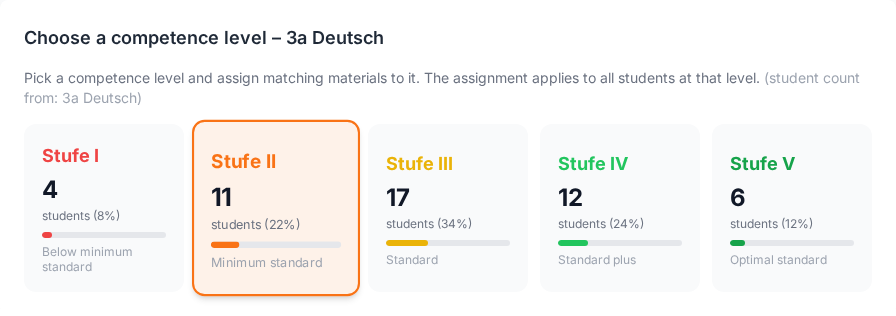
The package for the first route could look like this. The format is a proposal of this study, not part of the API, and has not been agreed with anyone. The level distribution comes from the demo application's sample data; the other numbers are set for illustration. The field names are German, as in the rest of the project:
{
  "format": "tba3-ergebnispaket/0.1-entwurf",
  "erstellt": "2026-10-14",
  "test": {
    "name": "VERA 3 Deutsch",
    "bildungsstandards": "https://w3id.org/iqb/bista04-de-p/"
  },
  "lerngruppe": {
    "bezeichnung": "3a Deutsch",
    "fach": "Deutsch",
    "jahrgang": 3
  },
  "personenbezug": false,
  "teilbereiche": [
    {
      "kennung": "https://w3id.org/iqb/bista04-de-p/…",
      "bezeichnung": "Lesen – mit Texten und Medien umgehen",
      "kompetenzstufen": { "I": 0.08, "II": 0.22, "III": 0.34, "IV": 0.24, "V": 0.12 },
      "vergleich": { "ebene": "land", "mindeststandard_erreicht": 0.88 }
    }
  ],
  "kompetenzen": [
    {
      "kennung": "https://w3id.org/iqb/bista04-de-p/…",
      "kuerzel": "3.3",
      "bezeichnung": "Texte erschließen",
      "loesungshaeufigkeit": 0.61,
      "vergleich_land": 0.68
    }
  ]
}
- The identifier is an address; the code is just an extra.
kennungpoints to the standard in the IQB vocabulary as held by the ontology server MEM. A receiving system can look it up instead of having to maintain a list of codes per subject and version. The…stand for the identifiers the API does not deliver yet. The specification already has the field for them (competences[].id); it is just left empty. - The version of the standards is in the package. The 2004 and 2022 educational standards number the same content differently. Without the version, even an address cannot be mapped unambiguously.
personenbezug(personal data) is stated explicitly. A package with individual results would be a different package with different rules. The receiving system should not have to infer it from the content.
How the handover could work
Report (TBA3 front end)                  Learning system (e.g. AIS)
───────────────────────                  ──────────────────────────
1. Teacher opens the report
   for their class
2. "Hand over to learning system"
3. Package is created in the browser
   (group level only)
4. Handover as a file or a link  ─────▶  5. Assign the package to the
                                            teacher's learning group
                                         6. Resolve the identifiers
                                            (educational standard →
                                            own learning objectives)
                                         7. Suggestions for learning
                                            paths and material per level
                                         8. Teacher decides
For the handover in step 4 there are three routes, from simplest to most involved:
| Route | How | Advantage | Drawback |
|---|---|---|---|
| File | The teacher downloads the package and uploads it into the learning system, as with the Common Cartridge. | No connection between the systems; the teacher sees what is handed over. | One more step. |
| Link | The report opens the learning system and passes the package along at launch, for example as a parameter of an LTI launch. | One click. | Both systems have to know each other. |
| Server to server | The learning system fetches the results itself through the API. | Always current. | Needs access rights to the results; the hardest case for data protection. |
For a trial the file is enough. It keeps the systems cleanly apart and leaves the decision about passing on data where it belongs, with the teacher.
What is missing on both sides
| Side | What is missing | Effort |
|---|---|---|
| API (TBA3) | fill competences[].id and sub-areas with resolvable identifiers, include the version of the standards |
low; the fields are already there |
| Report front end | an export "Hand over to learning system" in the format above | low; similar to the cartridge export |
| Learning system (AIS) | an import for group results, assigned to a learning group and appearing in planning as a scope of kind standard |
medium |
| Learning system (AIS) | a mapping from the KMK educational standards to its own knowledge components, next to the existing mapping to state curricula | high; needs subject-matter review |
| Learning system (AIS), individual results only | a separate, clearly marked write path for the learning state that records source and date and flags the value as "estimated" | medium, but only after clarification by the states |
| States | clarifying whether and for what VERA results may be passed to a learning system; mandatory for individual results | open |
What follows
- Handing over group results is feasible and the easy case for data protection. It asks little of the TBA3 side: identifiers instead of codes, and an export.
- The identifiers are the lever again. Without them the media library
search fails, and without them a learning system cannot do anything with the
results either. Filling
competences[].idhelps all three sub-concepts at once. - The real work lies in the learning system. It has to map educational standards to its own learning objectives. That is subject-matter work, not technical work, and it decides whether the suggestions are any good.
- Individual results only after legal clarification. Technically, a link could be built so that neither system learns the other's identifiers. Whether it may be built is for the states to decide.
- For a trial with AIS the grades have to match. In the pilot (grades 5 and
- there are no fresh VERA results. One option would be to use the VERA 3 results as a starting point after the transition to secondary school. But by then they are about one and a half years old and usually come from a different school, the primary school.