Die Demoanwendung zeigt, was eine Oberfläche mit den Antworten der Auswertungsschnittstelle anfangen kann. Daneben entstanden Teilkonzepte für das, was über die Schnittstelle hinausgeht: Lässt sich ein fremder Dienst anbinden, und bringt das den Lehrkräften etwas?
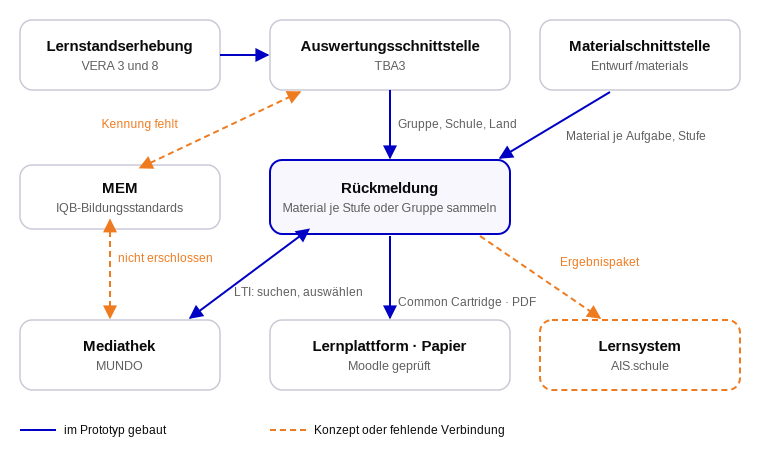
Prototypen, keine Produkte. Was in der Studie gebaut wurde, beantwortet die Frage geht das, und was wäre dafür nötig?. Es ist keine Empfehlung für den Betrieb und kein Teil der Schnittstelle.
Die Teilkonzepte
| Teilkonzept | Prototyp | Ergebnis in einem Satz |
|---|---|---|
| Mediatheken einbinden: Material aus MUNDO direkt einer Kompetenzstufe zuordnen | Reiter „Lernmaterialien“ der Demoanwendung, Anbindung über LTI 1.1 | Technisch machbar. Hilfreich aber nur für Lehrkräfte, die schon wissen, was sie suchen. Eine Suche, die von der Rückmeldung ausgeht, scheitert an fehlenden Metadaten auf beiden Seiten. |
| Materialsammlung an das LMS übergeben: Material, das zu einer Rückmeldung gesammelt wurde, geht als Common Cartridge an die Lernplattform oder als PDF aufs Papier | Export im Reiter „Lernmaterialien“ | Machbar, und zwar ohne Server. Moodle importiert die Cartridge, seit der Export Common Cartridge 1.1 schreibt. Sie transportiert Gliederung und Verweise, nicht das Material selbst. |
| Ergebnisdaten zur Weiterarbeit übergeben: Ergebnisse einer Rückmeldung an ein Lernsystem geben, am Beispiel AIS.schule | Konzeptentwurf, kein Prototyp | Für Gruppenergebnisse machbar und ohne Personenbezug. Voraussetzung sind auflösbare Kennungen je Kompetenz; Einzelergebnisse brauchen zuerst eine Klärung durch die Länder. |
| Ein Assistent, der die Auswertung lesen kann: ein Sprachmodell stellt die Abfragen selbst zusammen | MCP-Server im Repository (mcp-server/) |
Technisch machbar und stark bei Fragen, die mehrere Abfragen kreuzen. Die Hürde ist der Datenschutz: Im Pilot gehen auf Nachfrage Einzeldaten an das Sprachmodell. |
The demo application shows what a front end can do with the responses of the reporting API. Alongside it, sub-concepts were developed for what goes beyond the API: can an external service be connected, and does that help teachers?
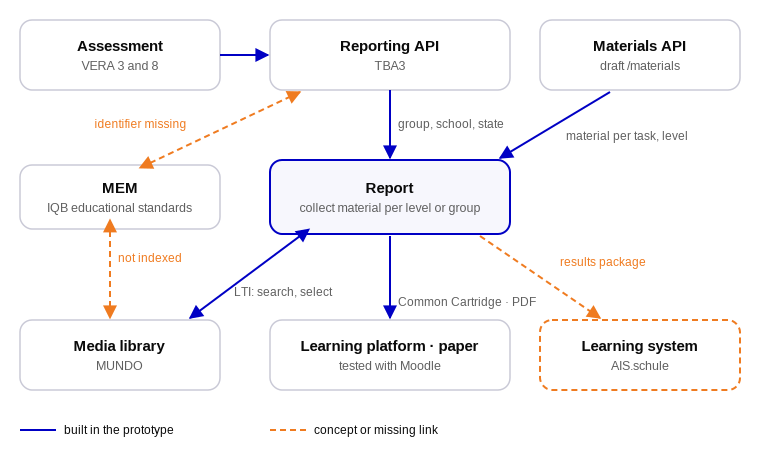
Prototypes, not products. What was built in the study answers the question is it possible, and what would it take?. It is not a recommendation for operation and not part of the API.
The sub-concepts
| Sub-concept | Prototype | Result in one sentence |
|---|---|---|
| Integrating media libraries: assigning material from MUNDO directly to a competence level | "Learning materials" tab of the demo application, connected via LTI 1.1 | Technically feasible. Useful only to teachers who already know what they are looking for. A search that starts from the report fails because metadata is missing on both sides. |
| Handing a material collection to the LMS: materials collected for a report go to the learning platform as a Common Cartridge, or to paper as a PDF | Export in the "Learning materials" tab | Feasible, and with no server involved. Moodle imports the cartridge since the export writes Common Cartridge 1.1. It carries the structure and the links, not the materials themselves. |
| Handing over result data for further work: passing a report's results to a learning system, using AIS.schule as the example | Concept draft, not a prototype | Feasible for group results, with no personal data. It requires resolvable identifiers per competence; individual results first need clarification by the states. |
| An assistant that can read the results: a language model assembles the queries itself | MCP server in the repository (mcp-server/) |
Technically feasible and strong for questions that cross several queries. The hurdle is data protection: in the pilot, individual data goes to the language model when asked. |